GBP/USD Extends Decline Below Support as UK Inflation Rises and Fed Tightens


UK inflation picked up in August, although the increase in price pressures was largely concentrated in fuel, transportation and travel-related costs. Core inflation and services inflation remained relatively stable, suggesting that underlying domestic price pressures have yet to strengthen significantly.
Meanwhile, the Federal Reserve tightened monetary policy further while raising its projections for economic growth, inflation and interest rates, prompting markets to reassess the outlook for US monetary policy and providing some support to the US dollar.
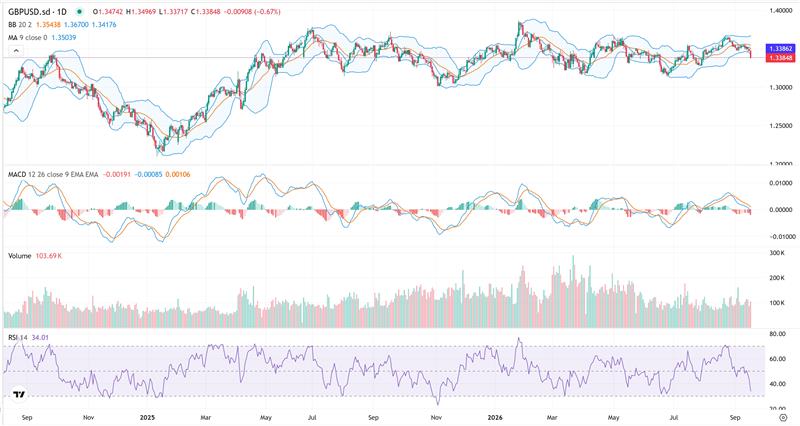
Against this macroeconomic backdrop, GBP/USD has continued to retreat and has broken below important technical support levels. Multiple technical indicators have also weakened, pointing to increased selling pressure in the short term.
Macro Outlook
UK Inflation Rises, but Underlying Price Pressures Remain Relatively Stable
UK inflation accelerated again in August, with the Consumer Price Index (CPI) rising 3.1% year-on-year, up from 2.9% and reaching its highest level since March. On a monthly basis, CPI increased 0.5%, while CPI including owner occupiers’ housing costs rose to 3.3% year-on-year.
However, the increase in price pressures was not broad-based.
Core inflation remained unchanged at 2.6% for the fourth consecutive month, while services inflation held at 3.4%. Food and non-alcoholic beverage prices increased by only 1.3% year-on-year.
Transportation was the primary driver behind the increase in headline inflation. Annual transport inflation accelerated from 3.6% to 4.6%, while motor fuel inflation climbed sharply from 15.5% to 23.0%.
Over the month, petrol and diesel prices rose by 9.1 pence and 14.2 pence, respectively. Airfares also increased 6.2% month-on-month, significantly more than during the corresponding period last year.
By contrast, prices for furniture, clothing and footwear remained relatively subdued, partially offsetting the broader increase in inflation.
Overall, the latest CPI increase appears to have been driven predominantly by fuel and travel-related costs rather than a broad acceleration in domestic price pressures.
Fed Raises Rates as Markets Reassess the US Policy Path
In the United States, the Federal Reserve voted unanimously to raise the federal funds target range by 25 basis points to 3.75%–4.00%.
The decision reflected continued resilience in economic activity, relatively limited changes in labour-market conditions and inflation that remains elevated.
The Fed’s latest economic projections also showed higher expectations for growth, inflation and interest rates.
Median GDP growth forecasts were raised to 2.3% for 2026 and 2.4% for 2027, while the unemployment rate was projected at 4.1% in both years.
The Fed also raised its 2026 inflation forecasts, with headline PCE inflation projected at 3.7% and core PCE inflation at 3.4%.
Meanwhile, the median policy-rate projection for the end of 2026 increased from 3.8% to 4.1%, with the 2027 projection also standing at 4.1%.
However, these projections do not necessarily point to a series of aggressive rate increases following the latest move.
Market reactions were mixed. US Treasury yields moved lower, the US dollar strengthened modestly, and the Dow Jones Industrial Average was broadly unchanged as investors continued to reassess the likely pace of monetary policy adjustments ahead.
Technical Outlook
GBP/USD Breaks Below Key Support
From a daily technical perspective, GBP/USD has continued to retreat from above 1.3600, with the pair recently falling toward 1.3385.
The price has moved clearly below its 9-day moving average and broken beneath the lower Bollinger Band at approximately 1.3418, suggesting that sellers have regained control in the short term.
The previous consolidation area around 1.3500 has also been breached, indicating that the current correction has yet to show a clear sign of stabilisation.
On the downside, 1.3350 is the first area to watch for potential support, followed by the 1.3300 region.
If GBP/USD can recover quickly above 1.3420, pressure associated with the break below the lower Bollinger Band may begin to ease.
Beyond that, resistance is located around 1.3500 and 1.3540. A sustained recovery above these levels would be needed before the pair could begin to move away from its current weaker technical structure.
Momentum Weakens, but Oversold Conditions Are Approaching
Momentum indicators reinforce the deterioration in the short-term technical picture.
The 14-day RSI has fallen toward 34, down significantly from above 60 previously. This indicates a clear increase in selling momentum, although it also suggests that GBP/USD is moving closer to oversold territory, increasing the possibility of a technical recovery if the decline continues.
MACD has also weakened. The fast and slow lines are moving lower and have formed a bearish crossover, while the histogram has moved back below the zero line and negative momentum has expanded, reinforcing the recent decline in price.
The Bollinger Band midline currently sits around 1.3544, with the upper band near 1.3670 and the lower band around 1.3418.
With GBP/USD already trading below the lower band, short-term weakness remains evident. However, the rapidly widening distance between the current price and the Bollinger midline also means that caution may be warranted when assessing the scope for further downside at current levels.
The 1.3350–1.3300 region will therefore be an important area to monitor for signs of stabilisation.
Outlook
Overall, GBP/USD’s technical structure has shifted from consolidation toward a weaker bias. Both RSI and MACD indicate that bearish momentum currently has the upper hand, while the break below the lower Bollinger Band reinforces the deterioration in the short-term picture.
At the same time, the pair is gradually approaching short-term oversold territory.
If the 1.3350–1.3300 support zone holds, GBP/USD could see an opportunity for a technical rebound. A decisive break below this region, however, could leave room for the correction to extend further.
On the upside, 1.3420 has become the first important recovery level. Until GBP/USD can regain the 1.3500–1.3540 region, the broader near-term structure is likely to remain weak.
This material is provided for general information and market commentary purposes only and does not constitute investment advice. Past performance is not indicative of future results. Your capital is at risk.
Related Posts